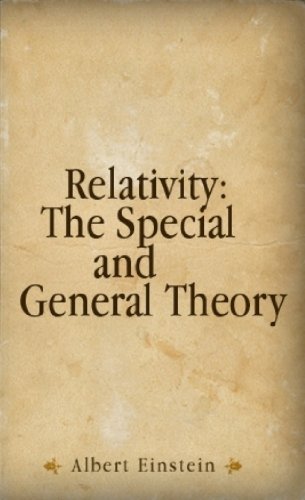
RELATIVITY - THE SPECIAL AND GENERAL THEORY - ORIGINAL 1916 VERSION - ALBERT EINSTEIN ***PLUS The Einstein Theory of Relativity A Concise Statement - ORIGINAL ... IN ONE ORIGINAL ENGLISH VERSION KINDLE BOOK Review

Thanks to all customers,the product order with us.
RELATIVITY - THE SPECIAL AND GENERAL THEORY - ORIGINAL 1916 VERSION - ALBERT EINSTEIN ***PLUS The Einstein Theory of Relativity A Concise Statement - ORIGINAL ... IN ONE ORIGINAL ENGLISH VERSION KINDLE BOOK Overview
The original full 1916 publications of Albert Einstein's theories of relativity - Special Relativity (1905) and General Relativity (1915). Also included is The Einstein Theory of Relativity A Concise Statement by by Prof. H.A. Lorentz. Both books are packaged together and presented as one unique book published especially for kindle.Special relativity (SR) (also known as the special theory of relativity or STR) is the physical theory of measurement in inertial frames of reference proposed in 1905 by Albert Einstein (after the considerable and independent contributions of Hendrik Lorentz, Henri Poincaré and others) in the paper "On the Electrodynamics of Moving Bodies". It generalizes Galileo's principle of relativity—that all uniform motion is relative, and that there is no absolute and well-defined state of rest (no privileged reference frames)—from mechanics to all the laws of physics, including both the laws of mechanics and of electrodynamics, whatever they may be. Special relativity incorporates the principle that the speed of light is the same for all inertial observers regardless of the state of motion of the source.
This theory has a wide range of consequences which have been experimentally verified, including counter-intuitive ones such as length contraction, time dilation and relativity of simultaneity, contradicting the classical notion that the duration of the time interval between two events is equal for all observers. (On the other hand, it introduces the space-time interval, which is invariant.) Combined with other laws of physics, the two postulates of special relativity predict the equivalence of matter and energy, as expressed in the mass-energy equivalence formula E = mc2, where c is the speed of light in a vacuum.The predictions of special relativity agree well with Newtonian mechanics in their common realm of applicability, specifically in experiments in which all velocities are small compared with the speed of light. Special relativity reveals that c is not just the velocity of a certain phenomenon—namely the propagation of electromagnetic radiation (light)—but rather a fundamental feature of the way space and time are unified as spacetime. One of the consequences of the theory is that it is impossible for any particle that has rest mass to be accelerated to the speed of light.
The theory is termed "special" because it applies the principle of relativity only to inertial reference frames, i.e. frames of reference in uniform relative motion with respect to each other.Einstein developed general relativity to apply the principle more generally, that is, to any frame so as to handle general coordinate transformations, and that theory includes the effects of gravity. From the theory of general relativity it follows that special relativity will still apply locally (i.e., to first order), and hence to any relativistic situation where gravity is not a significant factor. Inertial frames should be identified with non-rotating Cartesian coordinate systems constructed around any free falling trajectory as a time axis.
General relativity or the general theory of relativity is the geometric theory of gravitation published by Albert Einstein in 1915. It is the current description of gravitation in modern physics. It unifies special relativity and Newton's law of universal gravitation, and describes gravity as a geometric property of space and time, or spacetime. In particular, the curvature of spacetime is directly related to the four-momentum (mass-energy and linear momentum) of whatever matter and radiation are present. The relation is specified by the Einstein field equations, a system of partial differential equations.

0 comments:
Post a Comment